

Jack in the Box (NASDAQ:JACK) is Quick Service Restaurant franchisor in the Western States of the US that is down -85% from ATH. The sharp decline of the stock price was started in April 2024 triggered by AB1228 law in California pushed minimum fast-food wages in restaurants with more than 50 stores to $20/hour starting April 2024, impacting both brands Jack and Del Taco.
The company has historically been very aggressive with the use of financial leverage (near 6x Net debt/EBITDA), using debt to fund share repurchases, the M&A of Del Taco and dividend payouts, while neglecting the re-investment into the business for organic growth. Under this plan JACK reduced the share count by 70% in the last 17 years.
Fortunately for shareholders, starting in February 2025 a new management took over and released the “Jack on Track” initiative. The strategy of the new executive team is to strengthen the balance sheet and simplify the business to return to organic growth. The proposed roadmap contains the following initiatives:
- Immediately stop the dividend.
- Considerably reduce share repurchases and only do them opportunistically.
- Divest the brand Del Taco to reduce debt and focus con the core Jack in the Box brand.
- Sell real estate assets to repay debt.
- Close within a year 10% of the Jack in the Box stores.
In the midst of this uncertainty and changes, the valuation of this stable and recurrent business has fallen to all time lows. It is very rare to find in the US market a company with such a low valuation multiple.
But this once in a blue moon opportunity is not free of risks. Macroeconomic, regulatory, demographic and asset-specific risks impacting the business should be understood before jumping into this opportunity that has a chance to produce explosive returns in a short amount of time.
In the write-up to day we discuss:
- What is the situation of the company after the Del Taco Divestiture?
- How much breathing room are the levers they still can pull going to provide? (Real estate sales, footprint realignment…)
- The updated financials
- How the new strategy of the company could shape the financials.
- What is the situation of the company once the upcoming debt maturities hit?
- Is bankruptcy avoidable?
- An in-depth analysis of catalysts and risks around this high-volatility opportunity.
- Our opinion on the upside and downside
Events subsequent our the initial equity research on Jack in the Box
When we published our initial research in August, the core debate around Jack in the Box (“JACK”) was whether a highly levered franchised QSR could execute a rapid simplification plan (“Jack on Track”) fast enough to
- Stabilize traffic
- Monetize non-core assets
- Avoid entering the 2026–2027 maturity wall with a still-stressed balance sheet.
Since then, the story has moved from “complex, but potentially salvageable” to materially higher-risk, for one central reason: the market has now put a price tag on Del Taco—and it is a distressed one.
Over the last months, we have also gained additional signal from operating trends. In our August work we already highlighted that Jack’s SSS were deteriorating meaningfully (notably: +0.4% in Q1 and -4.4% in Q2 for Jack, versus -4.5% and -3.6% for Del Taco in the same periods).
In other words: even early on, Jack was not “clean” while Del Taco was “the problem.” And the subsequent releases point to a further deterioration, including a -7.7% SSS report for Jack in the Box in the latest quarterly release (while Del Taco held at -3.9%).
This matters because JACK’s entire “deleveraging pathway” was built on three pillars:
- Divest Del Taco to simplify and raise proceeds.
- Monetize a portion of real estate (primarily franchised-site assets) at reasonable cap rates.
- Rationalize the footprint (block closures) and re-base capex/SG&A while traffic stabilizes.
The new information we have today does not necessarily break (1)–(3) as a plan. It breaks the confidence around the plan—because the magnitude and quality of the proceeds from (1) has now been revealed, and it is weak.
Before diving into the transaction, we also want to add one practical datapoint. We contacted management teams of other restaurant operators to gauge interest and likely buyer appetite for Del Taco. The feedback was consistent: they viewed Del Taco as a distressed asset. This was not a “strategic jewel” that would clear at a healthy multiple; it was an operationally challenged, shrinking brand being exited under pressure. The sale price ultimately supports that read. In view of the comparable results that we see from Jack in the Box and the geographical distribution of its restaurants, we infer that Jack in the Box could be an equally distressed asset.
Jack in the BOX sold DEL TACO
In August, our base framework assumed that the company would seek strategic alternatives for Del Taco and that this process—run professionally—could still generate a meaningful amount of cash to de-risk the balance sheet.
The initial piece discussed a wide “reasonable” proceeds range (with scenarios often anchoring meaningfully above what the market seemed to be discounting at the time). The recent investor write-up documents the announced agreement to sell Del Taco at $115 million, a figure that is not merely “below optimistic expectations,” but so low that it reframes the entire equity risk profile.
$115m is 80% below or $460 million lower than the 2021 acquisition price /
The key takeaway is what that implies:
- Del Taco was not sold at a “cyclical trough multiple.” It was sold at a distress price.
- Since Del Taco cleared at distress, then the entire portfolio is being viewed through a distress lens—and the market will question whether any asset monetization can be executed at management’s prior assumptions.
- A $115m outcome is a tangible signal that the balance-sheet repair may be underfunded relative to the operational deterioration happening simultaneously.
This is precisely why we view the sale as a negative “information event,” even though—mechanically—“any sale is better than no sale.” The price does not just reduce deleveraging proceeds; it changes the market’s belief about what the rest of JACK’s assets are worth in a forced-sale context.
What is the current situation of Jack
- Operating distress looks broader than Del Taco
One of the more uncomfortable developments since our August write-up is that Jack’s own SSS trend has not provided insulation.
What is particularly notable is that the last SSS release since our publication has been even worse for Jack than for Del Taco in the same window, despite Jack having, in theory, a sales mix and geographic exposure that should have been more resilient than Del Taco’s. The Q3 calendar 2025 SSS results of Jack were the among worst of all the industry major players, only surpassed by SweetGreen.
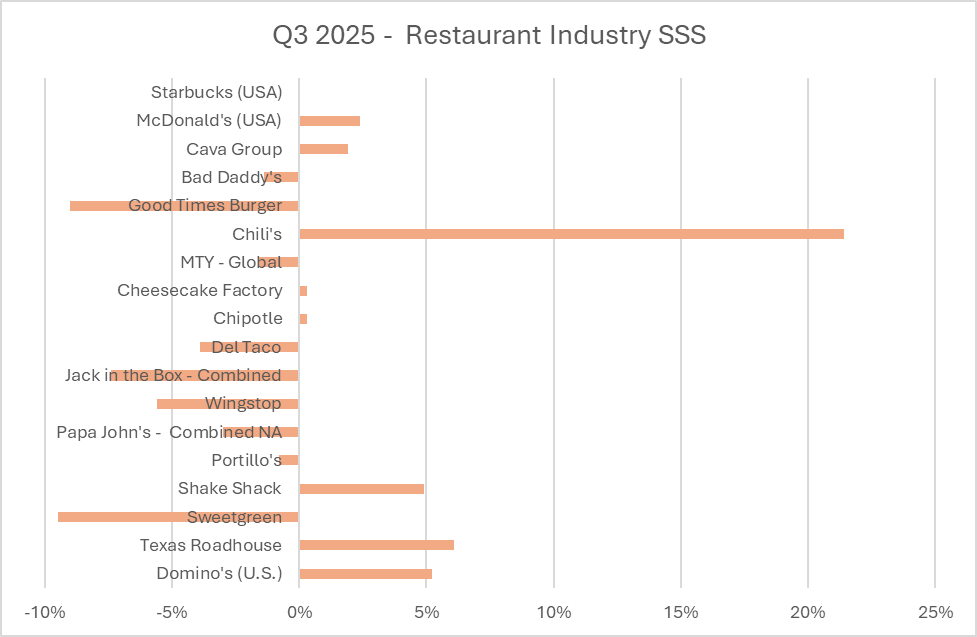
Our interpretation is straightforward: Jack may be exhibiting a similar level of distress to Del Taco, not a materially better one. If that is correct, the playbook becomes harder:
- The restructuring may require more marketing expenses than management hoped.
- Franchisee health and unit economics become a gating factor for closures, remodels, and any eventual return to unit growth.
- The equity becomes extremely sensitive to small forecast errors and the bankruptcy scenario gains probability.
- Restructuring costs are likely to be higher than originally promised
In August, we recognized the obvious: block closures, reframing the portfolio, and upgrading systems would generate one-offs and could trigger franchisee friction and litigation risk.
But the plan was still being underwritten by many as “a tough year, then stabilization.”
Today, the picture looks different. If Jack’s core operations are weakening at the same time the company is selling Del Taco at a distressed price, then the restructuring may need to be deeper, faster, and more expensive than management initially implied. This could show up via:
- Larger-than-expected franchise support / incentive packages (directly or indirectly).
- Higher closure-related costs (including lease and asset obligations).
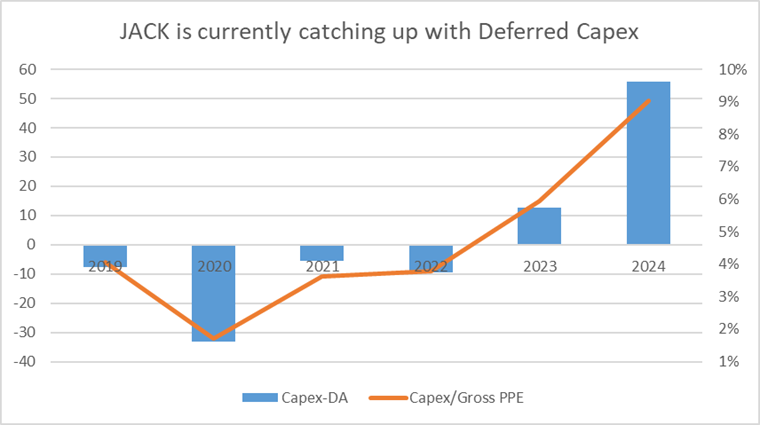
- A longer period of elevated capex and technology spending before the brand can credibly stabilize.
- Real estate monetization becomes more important—and more uncertain
In our original research, we made a point that is now even more central: real estate monetization is not just a “nice-to-have”; it is a critical lever in the deleveraging equation. (In the last write-up, we also expressed skepticism that management would achieve the ambitious valuation assumptions implied by their cap-rate commentary).
After the Del Taco sale price, this lever is more important for two reasons:
- The “Del Taco check” is smaller than what a non-distress scenario would require.
- If Del Taco was priced like a distressed asset, buyers may attempt to apply a similar discount mindset to other monetizations—especially if traffic continues to weaken.
- The Del Taco sale is showing the desperation and lack of cold head that Jack in the Box had as a seller: They needed the cash fast and at any cost to survive.
The company is now in a tougher situation: it needs real estate proceeds more than before, but it may be trying to monetize into buyer’s real estate market (especially in CA, TX, AZ and WA) and may not reward management’s prior cap-rate expectations.
- Leverage makes the equity a “fragile instrument”
At high leverage, small changes in operating assumptions can wipe out equity value.
That fragility is amplified when:
- Operating performance keeps deteriorating
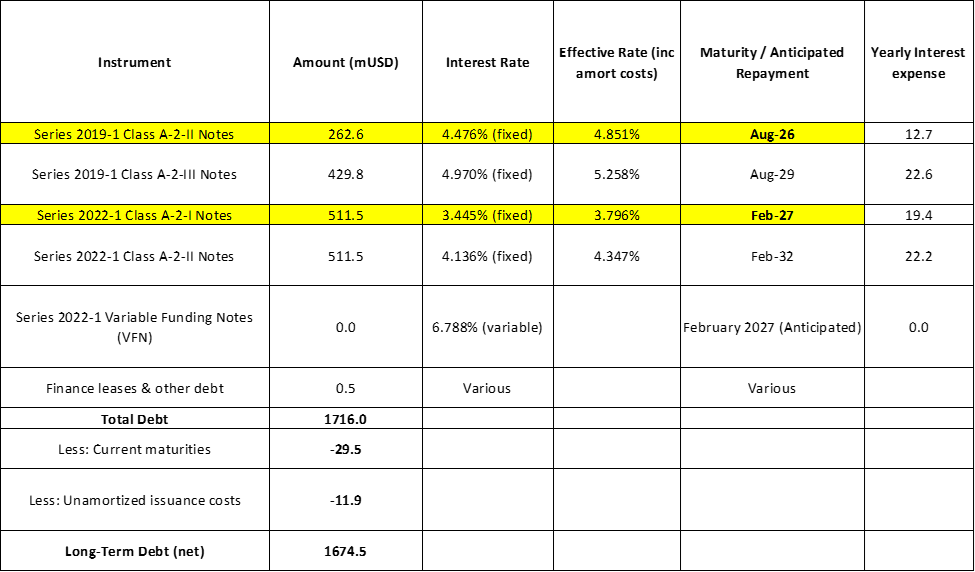
- Capital markets remain selective about refinancing risk (especially into 2026–2027).
In this environment, JACK equity is not “cheap.” It is a levered residual claim with path dependency—and the path has become narrower.

Opinion – Will Jack in the Box avoid bankruptcy?
Our view has turned materially more defensive.
The Del Taco sale price is not merely a disappointing outcome; it is a signal that the portfolio is being valued under stress and that the deleveraging plan is likely underpowered relative to the operational headwinds.
At the same time, Jack’s own operating performance has not provided the “core stability” that a clean divestiture story typically requires. With Jack’s recent SSS releases severely underperforming, we can no longer frame Del Taco as an isolated mistake being surgically removed. Meaning the restructuring could easily cost more—financially and culturally—than management initially signaled.
Because the risk profile has increased so meaningfully, we believe investors should be careful about buying the equity. If one wants exposure, we think it should be expressed only through optionality—specifically out-of-the-money puts—and only if implied volatility adequately compensates for the unusually high uncertainty and the fat-tailed distribution of outcomes embedded in this situation.
In other words: at this stage, JACK looks less like a misunderstood recovery and more like a high variance restructuring where the equity can be a poor vehicle for expressing a view. The deleveraging math now depends more heavily on real estate monetization at reasonable valuations, which we do not think is going to happen.
Today, JACK looks to as like a highly levered bet that the interest rates will come down faster than the market expects and that as a result, consumer sentiment will recover on time for Jack to avoid insolvency.