

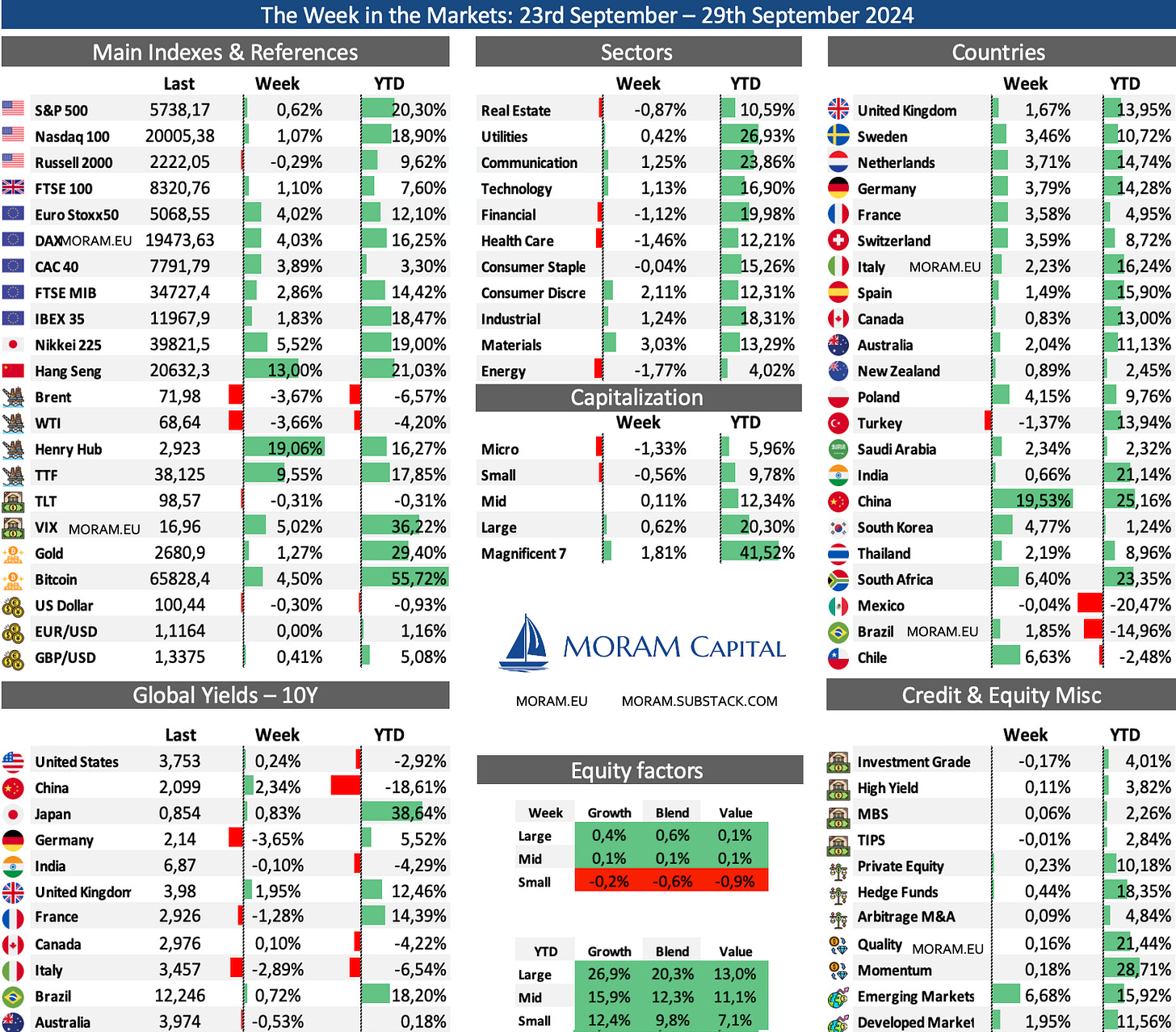
Great week for international markets thanks to the announcement of robust financial stimulus from China, with the MSCI China index appreciating by almost 20%. This has buoyed the European markets, which has risen more than 4%, mainly driven by luxury-related companies that were the best performers of the week (image below the section).
In the United States, the week has been quieter, although the S&P reached new all-time highs for the 42nd time this year. Once again, the Mag7 stocks outperformed the rest, boosted by Tesla and NVIDIA. On the downside, the Russell 2000 was the only major index to end the week in the red.
Overall, everything related to China led the gains this week. In terms of sectors, Materials, and especially Chemicals, were the best performers. Technology stocksalso outperformed, thanks to renewed optimism surrounding AI. Intel was one of the top performers, helped by reports of a possible takeover, and it was also supported by the fact that NVIDIA’s CEO had stopped selling his own shares in the company.
The worst of the week was oil, which has completed its horrible month, shedding more than 8%, dragging down the energy sector, which ended up being the worst of the week. Fears of a possible recession are weighing more heavily than any potential stimulus.
Gold was up for the third week in a row, closing just shy of its all-time high, near $2,700, while Bitcoin continues its journey back to its highs, currently around $66k.
The Emerging Markets index had its best week of the year, mainly thanks to China, which represents almost 30% of the index, but also supported by Chile, South Africa, Brazil… and a weaker dollar.
All of this happened in a week where the VIX, one of the major protagonists of the year, remained relatively calm (despite Friday’s +10%). Nothing suggests that this calm will continue, with just 5 weeks left until an election where nothing seems decided.
Highlights of the week
China
Some of the main measures announced by China this week
- Reserve requirement ratio cut: PBOC reduced the reserve requirement ratio for most banks by 50 basis points, the second cut this year.
- Short-term policy rate cut: The PBOC lowered its seven-day reverse repo rate by 20 basis points to 1.5%.
- Medium-term lending facility cut: The rate was reduced by 30 basis points to 2%, the largest-ever cut since 2016.
- Home mortgage rate cuts: A rate cut for existing home mortgages was announced, along with reducing the down payment ratio for second home purchases from 25% to 15%.
- Fiscal stimulus and real estate stabilization: China’s Politburo committed to stabilizing the property market and real estate prices, vowing fiscal spending to meet a 2024 growth target of 5%.
- Special sovereign bonds: China plans to issue about RMB 2 trillion (USD 284.4 billion) in special sovereign bonds, including RMB 1 trillion focused on boosting domestic consumption.
US PCE
The Fed’s preferred inflation gauge, the PCE index, showed a gain of 2.2% in the 12 months ended August, not far from the Fed’s 2% target. This measure was at 3.4% and 6.6% one and two years earlier, respectively. Core prices in this gauge (excludes volatile food and energy items) rose 2.7% in August from a year earlier. 12-month core inflation one year ago was 3.8%, and two years ago, it was 5.4%
The Fed’s preferred inflation gauge, the PCE index, showed aYoY gain of 2.2% in August, its lowest level since February 2021. This marks a significant decline compared to 3.4% one year ago and 6.6% two years ago. Monthly, the overall PCE index increased by 0.09% in August, after a 0.2% rise in July, aligning with market expectations.
- 12-month annualized rate: 2.2%
- 6-month annualized rate: 1.9%, the lowest since September 2020
- 3-month annualized rate: 1.5%
The core PCE index (excluding food and energy) rose 2.7% YoY in August, compared to 3.8% a year ago and 5.4% two years ago. On a monthly basis, core PCE increased by 0.13%, slightly below the expected 0.2% rise and slowing from 0.2% in July.
- 12-month core rate: 2.7%, up from 2.6% in June and July, marking the highest level since April.
- 6-month annualized rate: 2.4%, the lowest since December.
- 3-month annualized rate: 2.1%
Breaking down by categories, service prices rose 0.2%, while goods prices fell 0.2%. Food prices increased by 0.1%, and energy prices dropped 0.8%.

These figures reflect a continued moderation in inflation, with both the overall and core PCE indicators slowing, which aligns with the Fed’s inflation target of 2%.
Europe
The likelihood of the European Central Bank (ECB) cutting interest rates in Octoberis now at 80%, according to Bloomberg. This expectation is reinforced by weakening eurozone business activity and falling inflation data.
Eurozone business activity unexpectedly contracted in September, with the HCOB Eurozone Composite PMI Output Index dropping to 48.9 from 51.0 in August, indicating a fall in new orders. The services sector nearly stalled as the post-Olympics boost in Paris faded, while manufacturing continued to contract at a faster pace. German business activity saw its sharpest decline in seven months, signaling a potential second consecutive quarterly contraction.
Meanwhile, inflation data in France and Spain support the easing narrative:
- France’s annual inflation fell to 1.2% in September from 1.8% in August, with the largest monthly CPI drop (-1.2%) since at least 1990.
- Spain’s annual inflation declined to 1.5%, and core inflation dropped to 2.4%from 2.7% in August.
These factors collectively strengthen the case for an ECB rate cut in October.
Some interesting Data about markets this week & YTD

Note: there is a small mistake on Euro Stoxx %