

The Week in the Markets
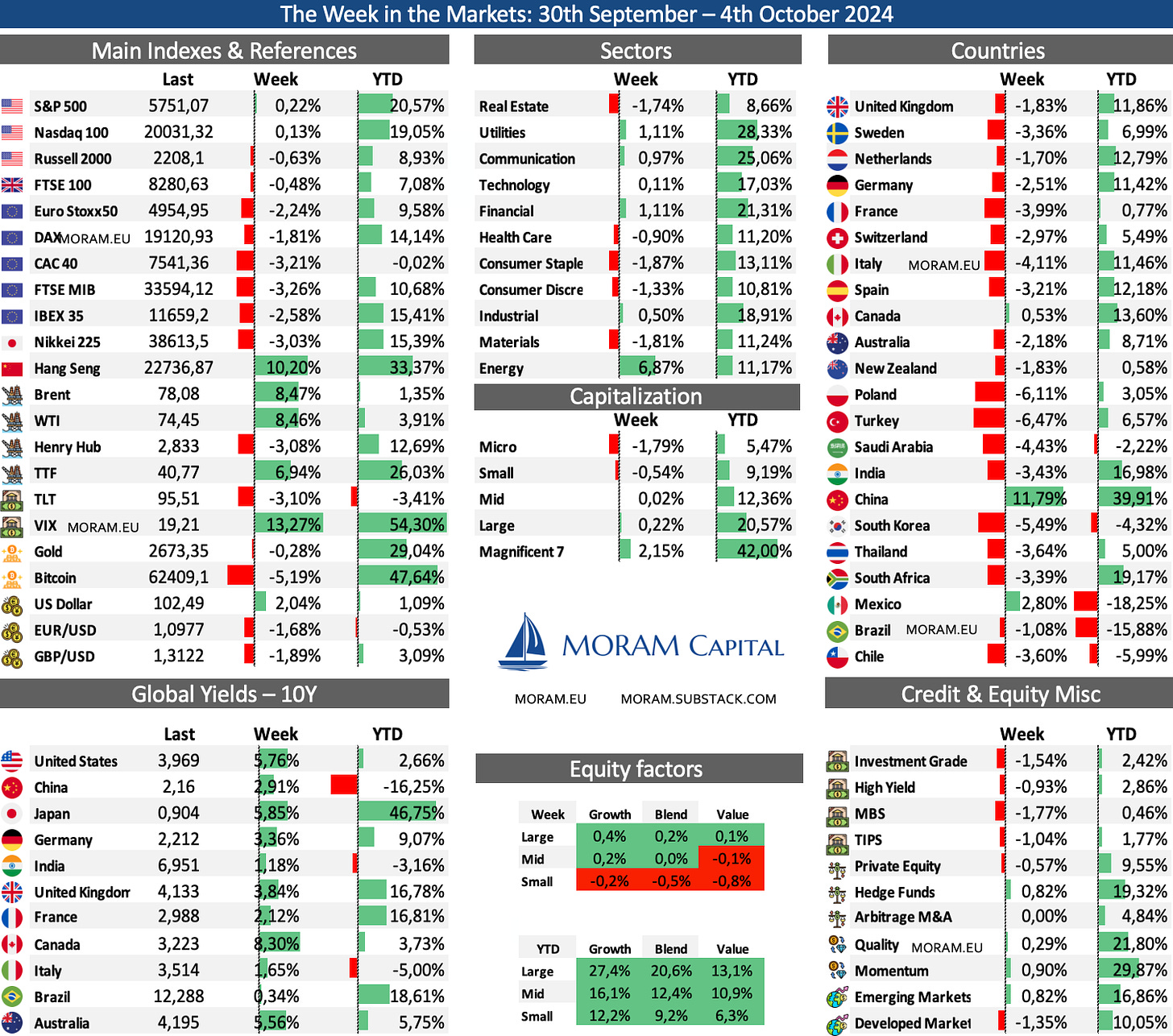
A tremendously volatile week due to the combination of economic and geopolitical events. Tensions in the Middle East, the ports strike on the U.S. East Coast, the surprising employment data, and the impact of recent measures in China were the major drivers of the week.
The main U.S. indices saw slight gains and distanced themselves significantly from their European peers (partly explained by the fact that what prevented the U.S. from closing in the red was the strong performance of the Magnificent 7 and the increasing evidence that their respective economies are moving at very different paces). Notably, Chinese stocks continue their recovery since the government announced stimulus measures two weeks ago.
The big winner of the week was oil, which rebounded nearly 10% due to the attacks by Iran on Israel. If the implications of the conflict extend to the Red Sea, the spike in prices could be much larger. Exxon gained almost 10%, and the energy sector was by far the best performer of the week.
It’s interesting to observe the asset flows this week as the news developed. Small caps, which had been the most affected by market jitters and the volatility spike (with the VIX nearing 21 on Thursday), recovered after Friday’s employment report. The dollar acted as a safe-haven asset throughout the week and ended up appreciating more than 2% against other currencies. Meanwhile, the 10-year bond yields recovered after the employment data, and the U.S. 10Y closed near 4%, as rate cut expectations fell.
Emerging markets (which we have discussed extensively in recent weeks) are now up 16.66% year-to-date (and almost 20% in the last two months), driven largely by the Chinese recovery.
Highlights of the week
US East Cost ports strike (maritime containers transport) – Earlier this week, the International Longshoremen’s Association went on strike, affecting 36 East Coast ports and causing estimated daily losses of $1 to $5 billion. Despite the disruption, the strike was resolved after three days with a wage agreement, granting workers a 62% raise over six years, increasing average wages from $39 to $63 per hour.
While the wage hike may be mildly inflationary, the short strike avoided more severe economic consequences. Temporary disruptions in the labor market from the strike and Hurricane Helene may raise jobless claims, but conditions are expected to normalize over time.
Middle East conflict – This week saw a sharp escalation in Middle East tensions as Israel faced an Iranian missile strike, which led to an initial spike in oil prices, safe-haven assets like gold and Treasury bonds, and a surge in the VIX volatility index. However, as the week progressed, the market reaction eased, with Treasury bonds, gold, and the VIX index all reversing their gains. Despite this, oil prices remained elevated, with WTI crude rising over 10% this week, reflecting concerns about potential disruptions to global energy supplies due to the conflict.
Employment Data

In the lead-up to the crucial U.S. elections, a strong employment report was released on Friday. Non-farm payrolls increased by 254,000 in September, surpassing the previous 12-month average of 203,000. Additionally, job revisions for July and August added 72,000 more jobs than previously reported – Honestly, we expects adjustments to this figure in the future, but let’s take what we have today –
Report highlights:
- Food and beverage services saw a massive rise of 69,000 jobs.
- Healthcare added 45,000 jobs, slightly below its recent average.
- Government employment rose by 31,000.
- Social assistance gained 27,000 jobs, and construction added 25,000.
The unemployment rate dropped to 4.1%, and 430,000 more people were employed—the largest increase since March. Full-time employment saw a jump of 631,000, while part-time employment fell by 201,000.
Interest rates cuts
After the publication of the data, market expectations regarding rate cuts readjusted, and the market now prices in two more rate cuts of 25 bps in 2024

In fact, Timiraos, the chief economist at The New York Times who leaked the 50 bps cut when everyone was expecting 25 bps, published a tweet yesterday at market close that literally said FED is going to cut rates by 25 bps in November.
You can make all the predictions you want, but sometimes the simplest information is right in front of you, and it seems that everything has already been discussed for November.
In summary, looking at the events of this week in the markets, we see reasons for both optimists and pessimists to maintain their theses.
On the optimistic side: Markets are once again near highs, China is implementing stimulus measures, the port strike (an inflationary threat) has been resolved, and employment data seems to confirm that the long-awaited soft landing could become a reality in the coming months.
On the pessimistic one: The Middle East appears to be a true pressure cooker, employment data raises certain suspicions and fears of an adjustment in the coming months, and there’s the volatility associated with the U.S. elections just around the corner.
For our part, we may have a contrasted opinion on what we think will happen; however, what’s important is to be clear about what to do in each situation and how to protect oneself and take advantage of each outcome.
Some interesting Data about markets this week & YTD
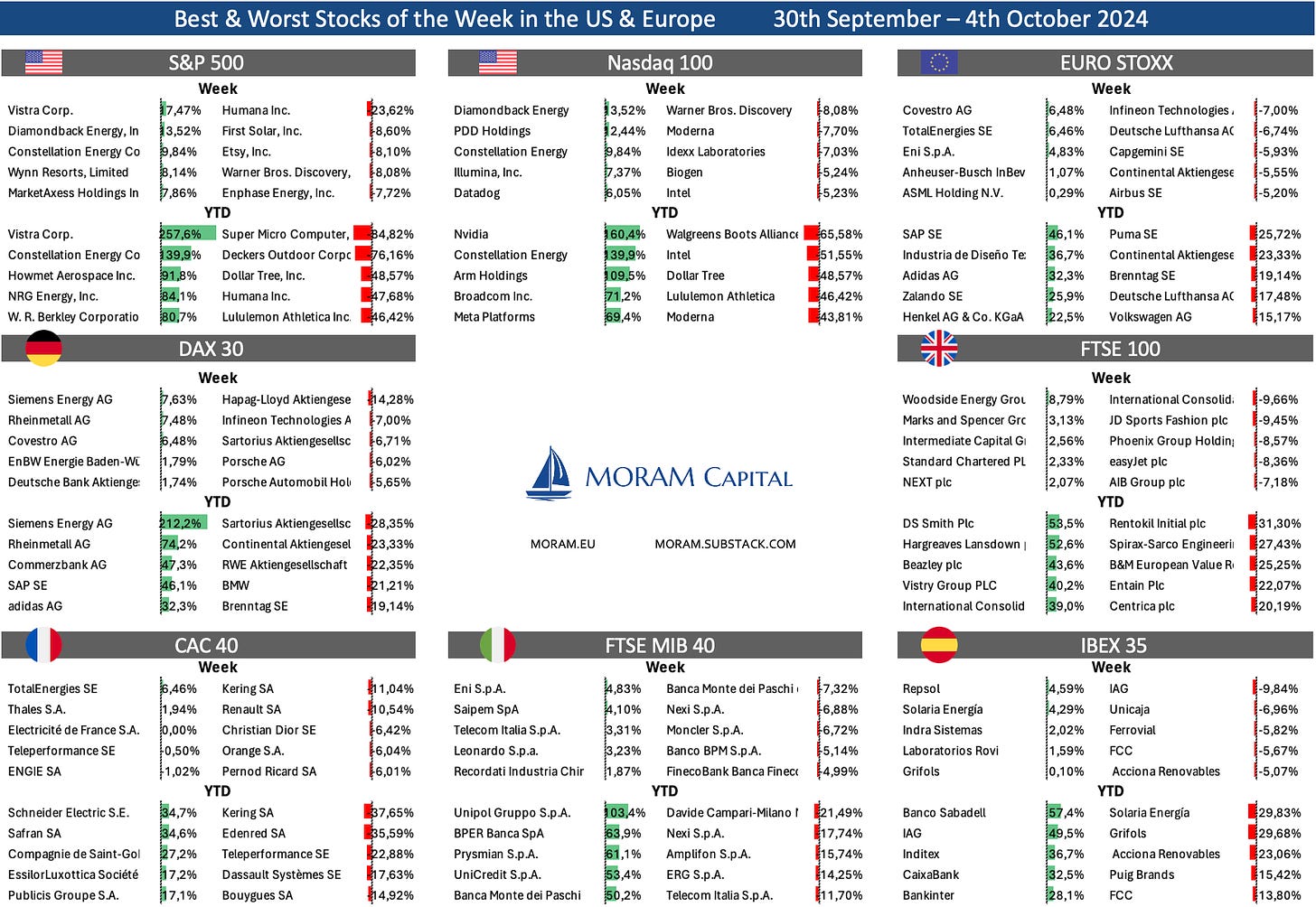
Real Estate and Utilities (the main beneficiaries of rate cuts) were the most notable performers in 3Q24, while on the other hand, Tech and Energy (hit by the collapse in oil prices during this period) were the worst performers.
